
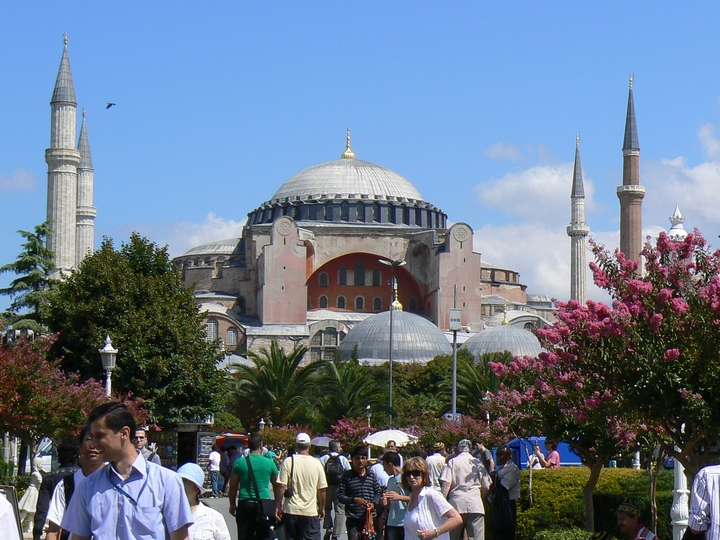
Blue Mosque and Hagia Sophia 7th Oct
Wake up at 9:30, shower then unpack jacket etc and put spent maps in case. Repack boot. Brian has made tea so have usual apple and bread breakfast. Just preparing to leave when message is delivered from Sergei Obolensky to say he has heavy cold, please ring later to arrange something for the morrow. Shelve glad rags and head for a mosque day.
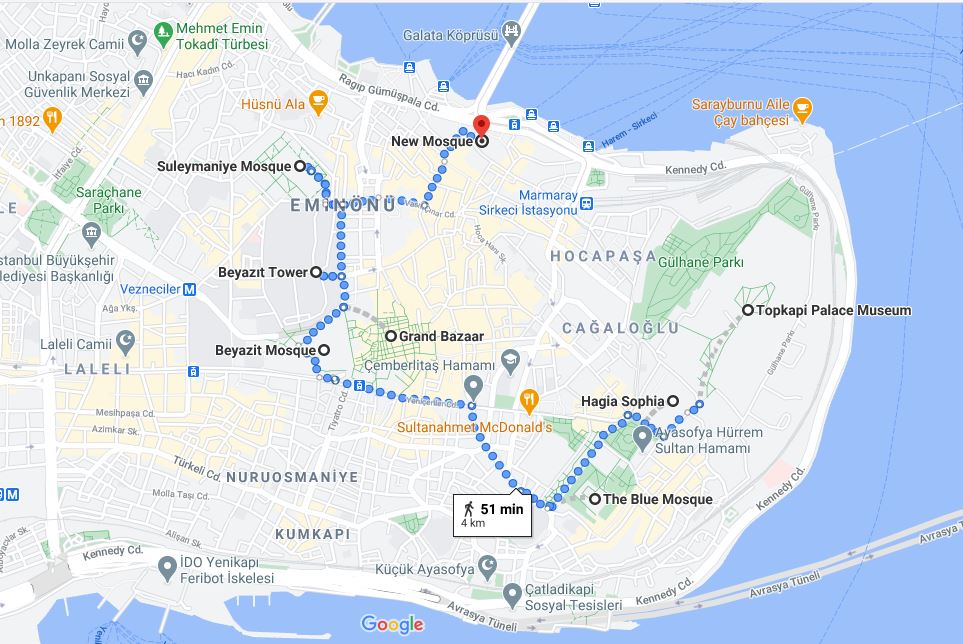
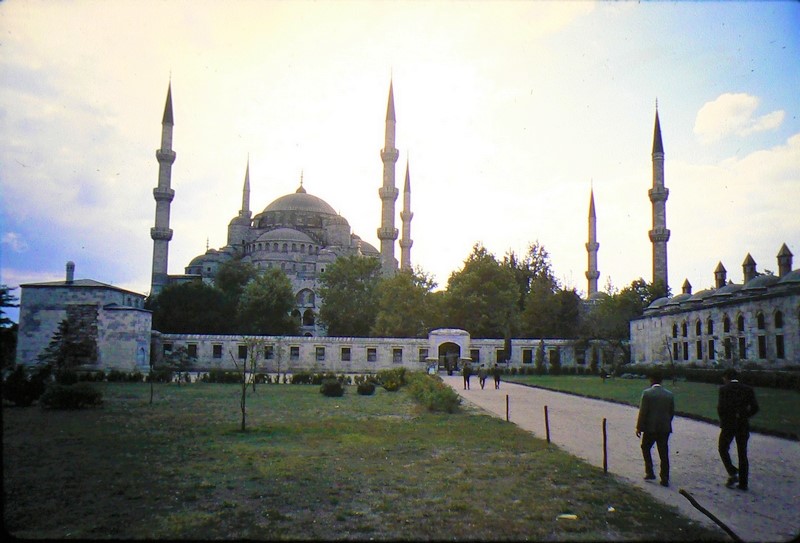
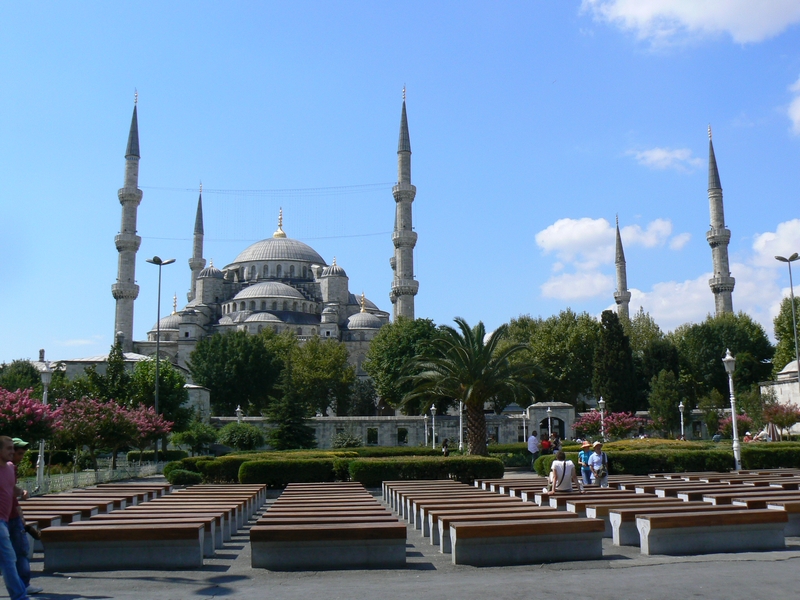
Into the now standard minibus to Aksaray Square. The underpass being constructed is impressive if inconvenient. Up towards mosque area go into café to make out plan of campaign. Decide what is most important, plan route accordingly. Take in Column of Constantine, Obelisk of Theodosius and German Fountain on the way to the Blue Mosque. This defies adequate description. Outside, in the courtyard (which has domes - painted on the inside round cloisters) the geometric pattern formed by all the interlocking domes leading up to the main dome seems to change, the domes "moving" relative to one another as we approach.
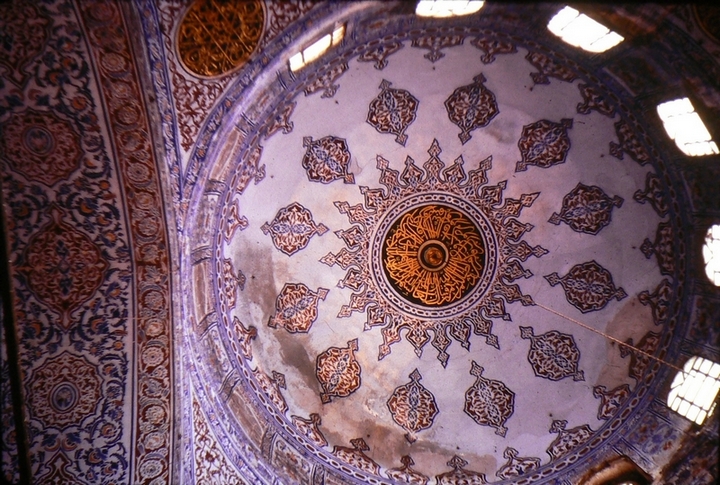
We get to the main entrance but are not allowed in immediately. Then off shoes and pad in. The floor, being rather uneven, is covered in matting on top of straw matting. The columns are immense leading up to a completely symmetrical ceiling arrangement of domes. The colour is, of course, basically blue. There is a gallery running round the inside of the main domes at the height of the top of the fluted columns. They are convex fluted unlike Greek columns. There are but four columns and they are really huge. The geometric patterns are very intricate and unravel their symmetry as you move round them - with the resulting neck ache.
At the east side private prayer is in progress. A young man seems to be wrestling as he goes through his ritual of self-abasement. Almost as if he wants to beat out his brains. He looks very penitent. An older man seems to have more difficulty with the fluid movement from the American football "scrum" position to prostration. But his prayer is nonetheless earnest. Others are whispering to themselves, lips moving almost soundlessly. After drinking in the atmosphere of this place of worship (completed in 1616) we go out towards St Sophia.
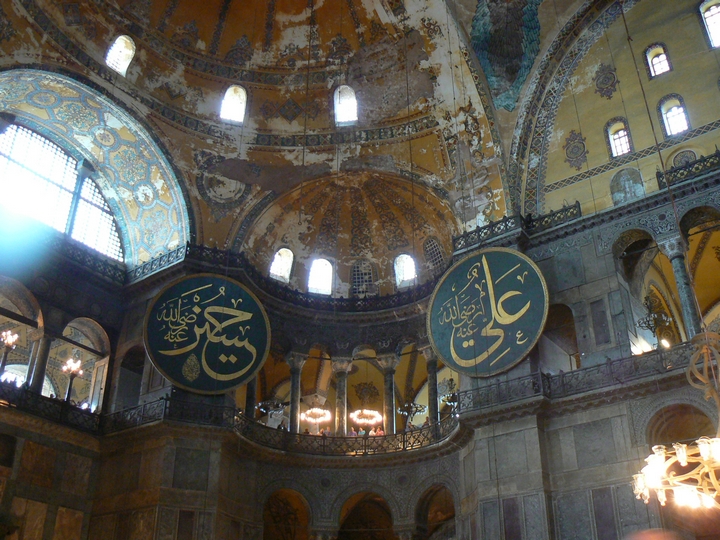
Hagia Sophia is more than just a museum. It costs 3TL to get in and no cameras. There is a gold mosaic of Christ in the entrance. Built in the 6th century AD it served as the Eastern Orthodox Cathedral until the 15th century and then as a mosque until 1931. Inside we feel the same overwhelming power of the place, despite the lack of carpeting, which gives the hall a greater echo. Their form of worship without pews lends much greater dignity to the building.
This ex-mosque is not in such good condition inside but for its age it is fantastic. It is lighter than the blue mosque but does not have the stained glass. It is built in the form of a basilica with aisles down the sides of the main hall. The pulpits in these places are reached by a vast stairway. Apart from the aisles which have Roman style columns and arches, though highly decorated capitals, there are no columns in the main church. Alexander, or whoever the emperor was, has his own box at the east end which is reached from outside at first floor level and has a heavy screen (for his wives?) The east end has an apse, with an "altar" in it, though this is off centre as is the dais on which it is raised. There is more intricate brass screen (with glass behind) on the south of the south aisle. To the west of the entrance chamber is a hall (corridor) with a few fragments of antiquity in it. In the main church are two large oval vessels which are both asymmetric. Made of stone which has been highly polished.